
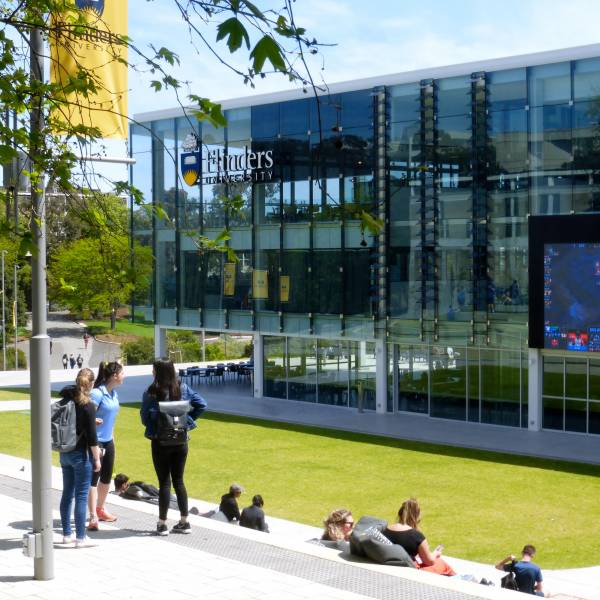
Flinders University has recognised the need to respond to the rapidly changing demands in higher education and to attain a greater share of the global market for higher education, attract the very best academic resources and exploit the potential for associations between innovation precincts and research funding.
Holmes Dyer assisted Flinders University through the preparation of the Flinders Precinct Master Plan which has involved a comprehensive evaluation of the University’s vision, analysis of market opportunities, site evaluation and review of the strategic and governance frameworks to produce an urban village concept which seeks to merge the education and research functions of the University with the daily operation of the surrounding community, business sector and local workforce.
The concept takes advantage of, and builds upon, the new Flinders Link train line extension and railway station to deliver a pedestrian focused urban village which incorporates a retail / commercial / community hub, an activated town square, extensive student accommodation and opportunities for health services expansion (associated with the adjacent hospital), as well as a range of education, research and commercialisation spaces, including indoor and outdoor recreation.
Holmes Dyer also provided advice in support of the financial analysis of the proposal and the reinforcement of concepts to meet required financial hurdles. This included directions to quantity surveyors and engineers on proposed site and building requirements.
The process of master plan preparation involved collection and analysis of a comprehensive array of building, infrastructure, site and locality data to establish the opportunities and constraints impacting upon the design of the Innovation Precinct. These investigations were supported by market analysis and trends and predication in student enrolments, onsite residency and international student growth. It involved communication with key stakeholders including Renewal SA regarding the Tonsley Innovation District, Flinders Medical Centre regarding growth requirements and interdependencies, Flinders Private Hospital regarding expansion of capacity, Department of Transport, Planning and Infrastructure regarding the delivery of and requested refinements to the Flinders Link Project (the railway and station), the development of appropriate planning policy for the campus, land tenure / ownership requirements to facilitate the delivery of a holistic Innovation Precinct outcome and coordination of key infrastructure delivery especially relating to the North-South Upgrade Project, and with both the City of Mitcham and City of Marion regarding matters of community, recreation, heritage and the environment.
The master planning process was further informed by an appreciation of the Flinders University Vision, a range of projects, initiatives and policy directions external to the University, the benchmarking of similar Universities and the identification of key drivers of change, both internally and externally and pertaining to education, research, technology, student expectations and accommodation requirements, spatial opportunities and desired urban form outcomes. The notion of an ‘urban village’ is fundamental to the successful creation of a vibrant, activated, diverse destination of choice in the face of the ‘online learning’ alternative.
The master plan evolved through spatial analysis and interpretation of land ownership, topography, vegetation, hydrology, land uses, service infrastructure, traffic, transport and movement systems, community, retail, business and commercial facilities availability, public open space, heritage, both Indigenous and European, built form and building performance, interface issues, helicopter access to the Hospital, existing availability and suitability of student accommodation, community services and facilities, retail floorspace, employment and car parking and the growth expectations of the University.
The master plan delivered extensive analysis mapping, existing and projected floorspace requirements by land use, land use arrangements, activity foci, identification of vacant and underutilised land, a structure plan for the wider precinct, a road, pedestrian, cycle and open space strategy, road, bus, train networks plans, urban form plan, carparking and access, arrangements, building heights and development yields, design outcomes, precinct concepts, floorspace delivery estimates and staging plans.
The implementation plan addressed State Government engagement, staging and timing, governance, a land ownership strategy and an approvals strategy and informed the University’s Business Plan.
Key Capabilities
-
- Master Planning and Urban Design
- Strategic Planning
